|

|
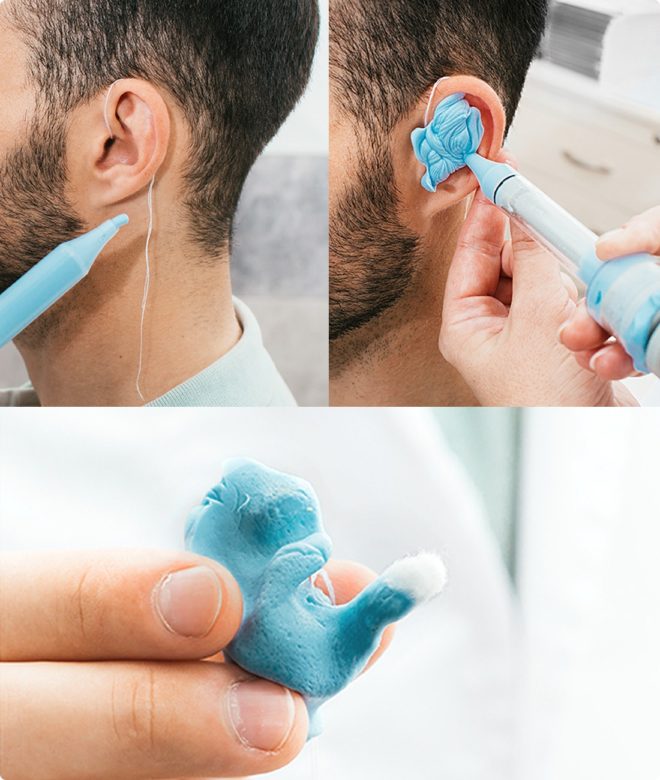
| Small open-fit hearing aid in place. |
Today hearing aids have gotten better than in ever before. At Tennessee Valley Audiology we
offer a wide range of technologies to meet the individual needs of our patients. We have technologies that can distinguish
between speech sounds and other sounds with the goal of trying to make the speech signal more distinct and clear. Some technologies
help you to hear better in social situations by recognizing the direction of sound and down playing interferring background
noise.
When you are seen at our clinic, Drs. Dennis and Patricia Earl make every effort to assess and understand
your hearing problems and offer an individual solution for your hearing loss. We carefully discuss how we may be able to help
you with various technologies and try to give you a realistic idea of what you may expect from the instruments. You need to
remember that no hearing aid will restore hearing to normal so trying to create an understanding of what may be realistically
expectated from the hearing aid fitting is critical to success. We are often asked
whether one or two hearing aids are indicated. Most of the time two hearing aids will deliver the best result especially in
the area of hearing in social situations. The reason for this is that our brains need a balanced input from two ears in order
for us to hear in background noise, especially if the background noise is also speech.
We classify hearing aids
into four levels of technology: economy, basic, mid-level and advanced technology. How we determine which technology is most
appropriate for a patient depends on several factors including level of hearing loss, word recognition ability, listening
situations where help is needed and financial concerns.
Financial concerns can dictate that less than ideal amplification
strategies are chosen. Although more simple technologies do not offer the same benefit in noisier situations, they do offer
help in many everyday situations. Economy hearing aids are priced around $1000; a basic technology aid from $1500
to $1800; mid-range technology is $1800 to $2000; an advanced aid ranges in price from $2300 to $2450 and premium technology
ranges from $2650 to $3000 per aid.
At Tennessee Valley Audiology we use all digital hearing aids from the most
respected manufacturers including Widex, Oticon, Phonak, GN Resound, Rexton, Starkey and Audiosync. Each of these
companies offer fine hearing instruments, but we do believe that all hearing aids are not the same and certain aids work better
for specific types of problems. Today, approximately 85% of hearing aids fit are of the behind the ear type (BTE). Prior to
2006, most hearing aids were some type of custom in the ear (ITE) style. Slim tube and receiver in the canal (RITE) hearing
aids allow for the ear canal to remain open. By keeping the ear canal open the hearing aid does not occlude the ear canal
which eliminates several problems that have been associated with hearing aids. Today, most hearing aid manufacturers have
this type of product. With custom aids and traditional BTEs, the external ears are mostly blocked which can cause a
change in the sound of your own voice when you talk or amplifying sounds of chewing. These new open BTEs have greatly changed
how hearing aids look and work.
Size of hearing aids and features are important considerations.
You have to think about whether you want hearing aids that are fully automatic or do you want to control them. (Even
if you control the hearing aids, they still automatically adjust to changes in sound around you.) Most small hearing
aids limit features such as telecoils and extra programs which may be needed or desired. Some hearing aids use remote
controls to control the hearing aids to allow you to control aids which is too small to put the manual controls which allow
you to manually operate the features on hearing aids. Remember, it is important to know yourself and to think about
whether you would prefer aids which are fully automatic or you can control. These are things to discuss at your visit
with Dr. Earl. Some of the hearing aids we use are the following:
Premium Hearing Aids: Widex Mind, Mini Mind, Mind Passion, Inteo, Mini Inteo, and Passion 440, Oticon
Epoq, Oticon Dual 9, GN Resound Live 9 and BE 9, Starkey S11 and the Phonak Exelia Art, Exelia Art micro and Exelia
Art Petite.
Advanced Hearing Aids: Widex Mind 330 and Passion 110,
Oticon Syncro 2 and Dual 7, Phonak Savia Art, Micro Savia Art and Yes, and Rexton Cobalt 16 and Insight.
Mid-level Hearing Aids: Widex Aikia, Oticon Vigo and Dual 5, Phonak Versata and GN Resound
Pulse/ Xplore and BE 7.
Basic Technology Hearing Aids: Widex Real, Real Mini
and Passion 105, Phonak Certena, Oticon Go Pro and Delta 4000, GN Resound Ziga and Reston Bridge. Economy Hearing Aids: Rexton Day, Starkey E, and Phonak Milo.
Web Links:
Widex
GN Resound
Phonak
Oticon
Vivatone
|